The MilitaryNerd | Online Edition #1258

Conflicts & Wars

An understanding of world conflict is vital in order to prevent future wars and predict their consequences: famine, massacres, mass displacement, persecution, collapsed governments, genocide, wartime deaths, and retribution killings.

Violent conflict still is the dominant condition for tens of millions of people and, alongside progress in governance, defines the momentum of history for most of the world’s peoples. Most of today’s wars are in the poorer countries of the world. As well, where one finds violent conflict, one also finds authoritarian governments.

Inevitably, there will be more horrible wars and innovations in mass destruction. War continues to be part of the birthing pain of emerging democracies. Peace in our time will depend, in part, on a broader international understanding of these problems, which can be promoted by more people reading websites like MegaMilitary.
37 results - showing 21 - 30
1 2 3 4
Germany’s strategy, decided long before the war, was to contain Russia on the Eastern Front and make a lightning attack on France; and having defeated that nation, transport the bulk of the German forces to mount an offensive against Russia, a plan made practical by the swift movement possible on the extensive railway system.
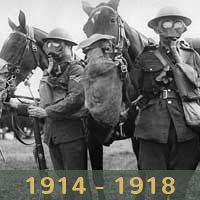
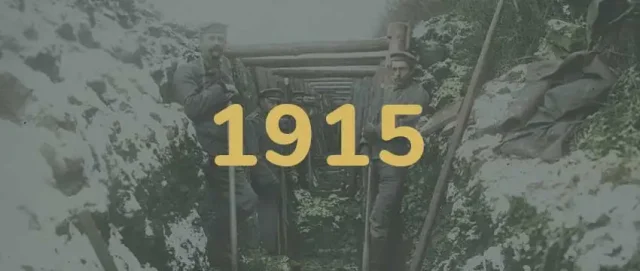
The dramatic sinking of the Lusitania by a german submarine marked the second year of World War I. Most notable were also the battles at Neuve-Chapelle, of Woëvre, the second battle of Ypres, Vimy Ridge, renewed fighting in Champagne and Artois and finally the battle of Loos.
1916 witnessed two of the most costly and least-inspired military operations in history, when both camps were already experiencing severe shortages of manpower (to the extent that in Britain it was necessary to institute compulsory military service for the first time). Both sides decided on offence.
Political changes had considerably influenced allied strategy on the Western Front. Asquith’s British administration, which had been compelled to change from its original Liberal composition to a coalition because of the Dardanelles mishandling, had fallen at the end of 1916 and David Lloyd George had been installed as prime minister. In France,...
The near collapse of Italy emphasized the Allied need to co-ordinate their actions, to which end a “Supreme War Council” was created at the Rapallo Conference (5 Nov-ember 1917). The Council, established at Versailles, was to meet regularly and include the prime Ministers of France, Britain and Italy, and the US president, or their representativ...
At 08:00 hours on August 31, 1939, a contingent of German soldiers masquerading as Poles “assaulted” a German customs facility on the Polish-German border and temporarily seized a German radio station. The “Poles” subsequently withdrew, leaving numerous corpses as evidence of the confrontation. The corpses, attired in German uniforms, were victi...
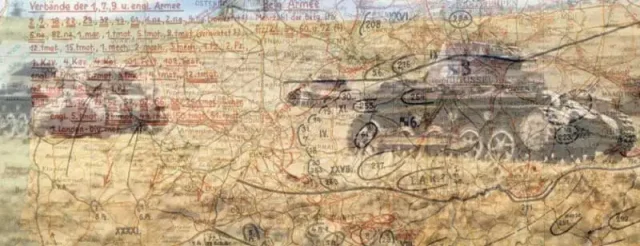
From Erwin Rommel's point of view, things did go “all fine.” Four days later, thanks to his daring leadership, his division pushed past the French positions on the River Meuse. In the days that followed, his tanks - and a host of tanks from other panzer divisions - surged into northern France, heading for the English Channel. By June 1940, Franc...
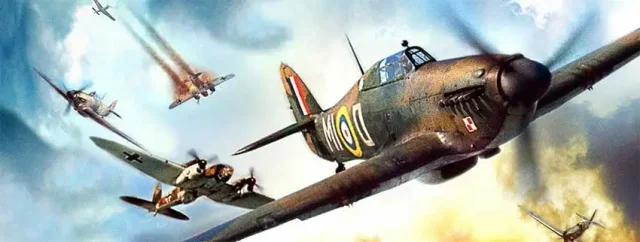
On September 7, 1940, shortly after 17:00 hours, nearly 300 German bombers, escorted by twice as many fighters, launched an attack on London's East End. They bombed Woolwich Arsenal, a power station, a gas plant, the docks, and the city. Two hours later, a further 200 bombers appeared. The bombing continued throughout the night, with the final a...

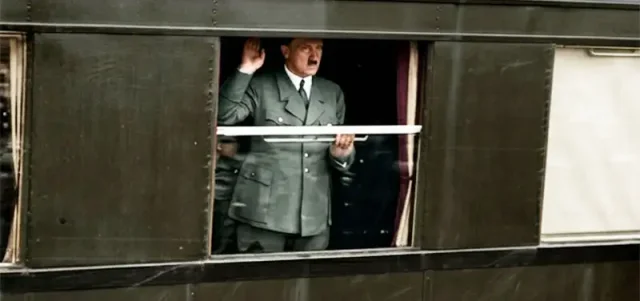
Adolf Hitlers Führersonderzug and Reich Chancellery (1939-1940)

Adolf Hitlers Military Headquarters WWII
By the summer of 1939 all military preparations for the planned attack against Poland, code-named ‘Case White’ (Fall Weiss), had been issued to the armed forces. As the second half of August 1939 began, German military chiefs pushed forward their final plans to destroy Poland and liberate its western parts from an area that was predominantly Ger...

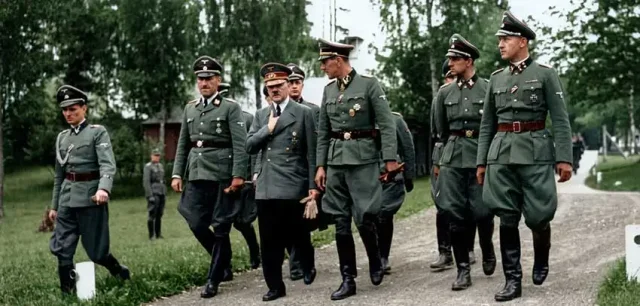
Adolf Hitlers Felsennest, Wolfsschlucht, and Tannenberg (1940)

Adolf Hitlers Military Headquarters WWII
The name ‘Felsennest’ was taken from a 400-meter-high wooded hilltop overlooking the hamlet of Rodert. The installation covered some 30 hectares with bunkers and a string of anti-aircraft emplacements with an assortment of barrack-type buildings.
37 results - showing 21 - 30
1 2 3 4

Latest Video...

Latest Content...

Long Reads...