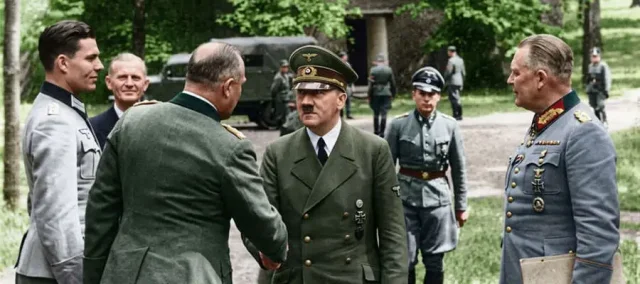
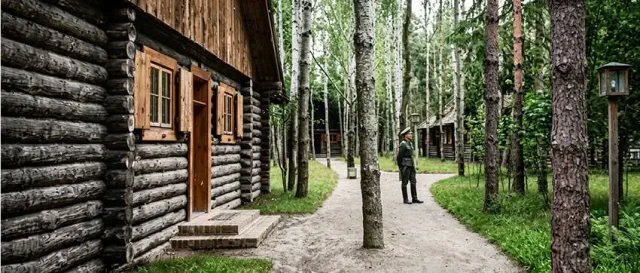
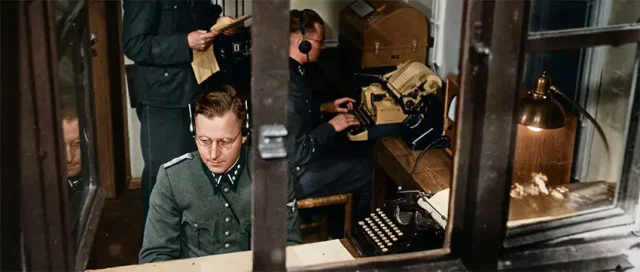
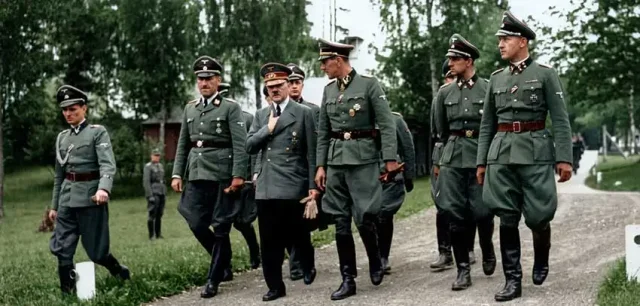
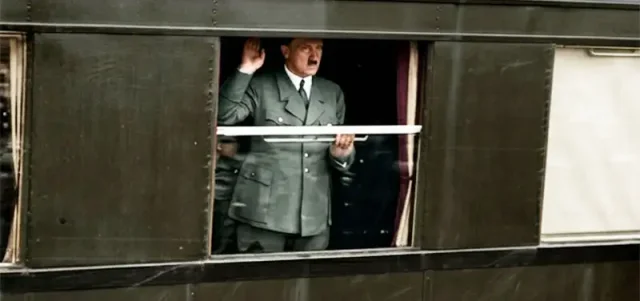
At 5.00pm on 1 December 1944, Hitler and headquarters staff secretly left the Reich Chancellery in Berlin bound for the Western Front. Eight hours later, under cover of darkness, he switched from the train to a waiting column of cars and drove to 'Adlerhorst,' the bunker headquarters built in 1940 at Bad Nauheim, 800 feet above sea level and ove...
At 'Wolfschanze,' Hitler began the New Year once again, fired with optimism. He had convinced the German people to stand fast in the face of the adversary, and through their iron will and fortitude, he promised them victory. In front of his war staff, he radiated that same confidence and instilled them with fresh hope and strength of mind.
With Bock's sacking, Hitler prepared to transfer his headquarters staff from ‘Wolfschanze’ to a newly constructed headquarters site deep in Ukraine. On 16 July 1942 at 8:15 a.m., his entire staff left ‘Wolfschanze’ and flew in sixteen planes to the new installation, which was situated six miles north of Vinnitsa, just east of the Vinnitsa/Shitom...
At first light on the morning of 23 June 1941, Hitler authorized that his special train, the Führersonderzug 'Amerika,' be readied to take him and his headquarters entourage by rail to East Prussia. He also requested that the various echelons of 'Supreme Headquarters’ follow ‘Amerika’ by either rail or air.
The name ‘Felsennest’ was taken from a 400-meter-high wooded hilltop overlooking the hamlet of Rodert. The installation covered some 30 hectares with bunkers and a string of anti-aircraft emplacements with an assortment of barrack-type buildings.
By the summer of 1939 all military preparations for the planned attack against Poland, code-named ‘Case White’ (Fall Weiss), had been issued to the armed forces. As the second half of August 1939 began, German military chiefs pushed forward their final plans to destroy Poland and liberate its western parts from an area that was predominantly Ger...
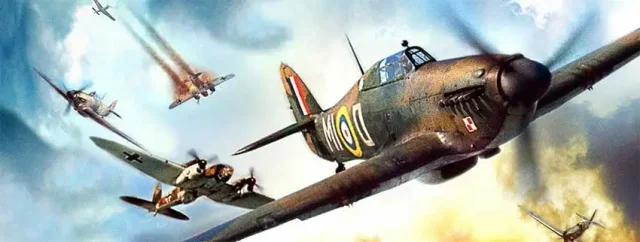
On September 7, 1940, shortly after 17:00 hours, nearly 300 German bombers, escorted by twice as many fighters, launched an attack on London's East End. They bombed Woolwich Arsenal, a power station, a gas plant, the docks, and the city. Two hours later, a further 200 bombers appeared. The bombing continued throughout the night, with the final a...
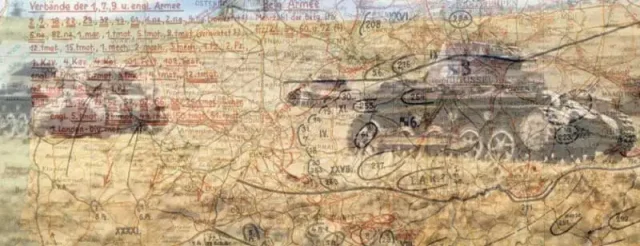
From Erwin Rommel's point of view, things did go “all fine.” Four days later, thanks to his daring leadership, his division pushed past the French positions on the River Meuse. In the days that followed, his tanks - and a host of tanks from other panzer divisions - surged into northern France, heading for the English Channel. By June 1940, Franc...